

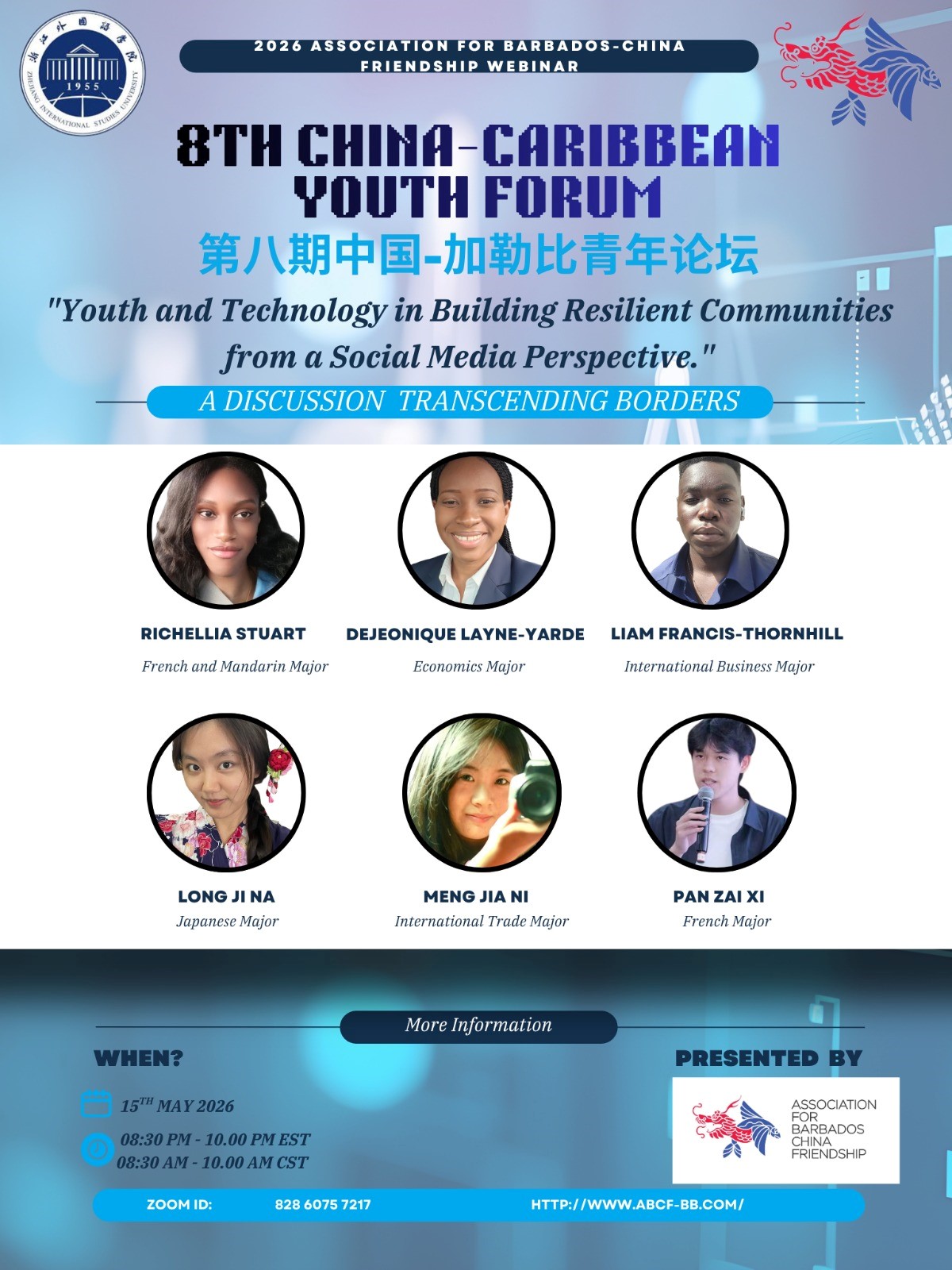
Announcing the 8th ABCF-ZISU Youth Forum
The 8th Youth Forum organized jointly by the ABCF and the Zhejiang International Studies University (ZISU) takes place on Zoom in the evening of May 15, 2026 in the Eastern Caribbean (the morning of May 16, 2026 in China) on the topic "Youth and Technology in Building Resilient Communities, from a Social Media Perspective." The progamme is put together and moderated by ABCF members who are students of the University of the West Indies in collaboration with students of ZISU, and the presenters are all university students. Join us to share the views of young people of different cultures as they exchange thoughts on a topic that is close to all our hearts.
Information on how to join is provided in the poster above. For further information, email the ABCF at the Association for Barbados China Friendship contact page.
A Fleeting Return of Focus Report - by Zichen Wang
In Junan County, Linyi City, Shandong Province, there is a project called the “Modern Agriculture Public Training Base,” with a total investment of more than 700 million yuan. Media reports once said that the project was “expected to serve 17,000 person-times annually,” that it would “make every effort to build a training base integrating agricultural varieties, technology, and services,” and that it was a “large-scale agricultural training base” capable of “simultaneously meeting the conference, training, dining, and lodging needs of more than 1,000 people.” Yet after this key project, once entrusted with great expectations, was completed, did it in fact fulfill its intended purpose? And was the huge investment really spent where it mattered most? Our reporters conducted an on-the-ground investigation.
Yao Yang: the post-2018 evolution in China's political economy
In his remarks, Yao argued that China’s reform and opening era effectively ended around 2018, ushering in what he described as a “new era.” He examined the leadership’s attempts to correct perceived excesses of the reform period while reorienting national resources toward manufacturing strength and technological self-reliance—an economic strategy that he linked to China’s broader strategic objectives, including reunification with Taiwan.
Yao also explored how these domestic priorities intersect with strategic competition between China and the United States, particularly in technology and industrial capacity, and outlined several possible scenarios for the future of the bilateral relationship.
From paper engines to winning engines - by Yuxuan JIA
In many ways, Zhang’s journey highlights a larger issue within China’s academic and industrial sectors, argued a recently viral article on Chinese social media.
The commentary, published on the WeChat blog Dream on 5 April 2026, draws on a comparison between the author’s doctoral supervisor, who made many “breakthroughs” on motorcycle engines within China’s academic research ecosystem, yet never been able to produce a commercially successful product, while Zhang, who, despite lacking formal academic credentials, managed to create a championship-winning motorcycle.
The article emphasises how China’s academic system, with its focus on publication and grant metrics, sidelines the gritty, exhausting trial-and-error process essential for real-world innovation. The fear of failure, which can derail academic careers, discourages risk-taking and experimentation. As a result, while academic institutions excel at producing theoretical breakthroughs, they often fail to translate those ideas into marketable technologies.
The larger question the commentary raises is: how can China bridge the gap between its academic research and practical innovation?
Lei Xiaoyan: the race between education and technology has come to China
A country with fewer children and more artificial intelligence will need a different kind of education system. And Lei Xiaoyan, Boya Distinguished Professor at Peking University, Party Secretary of the National School of Development (NSD), Director of the China Center for Economic Research (CCER), and Director of the PKU Center for Healthy Ageing and Development, argues that China must move quickly.
China has made major gains at lower levels of education. Primary and junior secondary schooling are now nearly universal for younger cohorts. But upper-secondary completion and tertiary attainment remain relatively low, especially among the generations that make up most of today’s workforce. Compared with the United States, the G7, and even Russia, China still has a relatively large share of adults without upper-secondary education. In Lei’s view, faster investment in human capital is therefore essential to contain inequality and keep common prosperity within reach.
Her reform argument is that employers increasingly value analytical thinking, resilience, creativity, judgement, and communication.
New Barbados South Coast restaurant offers authentic Chinese dishes

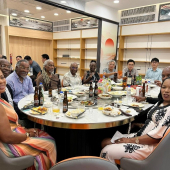
The G. L. Yummy House, ChinaDos complex, Maxwell Main Rd is now open for business, offering an extensive menu of dishes for take-out or dine in. Open Tuesday to Sunday for lunch and dinner. Call 419-8669.
This weekly newsletter is put together by DeLisle Worrell, President of the ABCF. Visit us at Association for Barbados China Friendship | (abcf-bb.com).
Thanks to everyone who sent contributions for this week’s Update. Please send items of interest to me via the contact page at ABCF-BB.com or to info@DeLisleWorrell.com
The ABCF mission is to build a deeper understanding between the Chinese people and Barbadians and Caribbean people from all walks of life. The association’s focus is on personal experiences, people-to-people contact, cultural exchanges and exchanges of ideas, and the facilitation of travel, business and study. From the outset we aim to learn from and build on the experiences of the Caribbean and China, and to develop mutual understandings and support that will be to the benefit of both sides.