
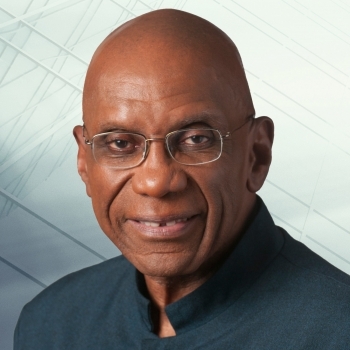
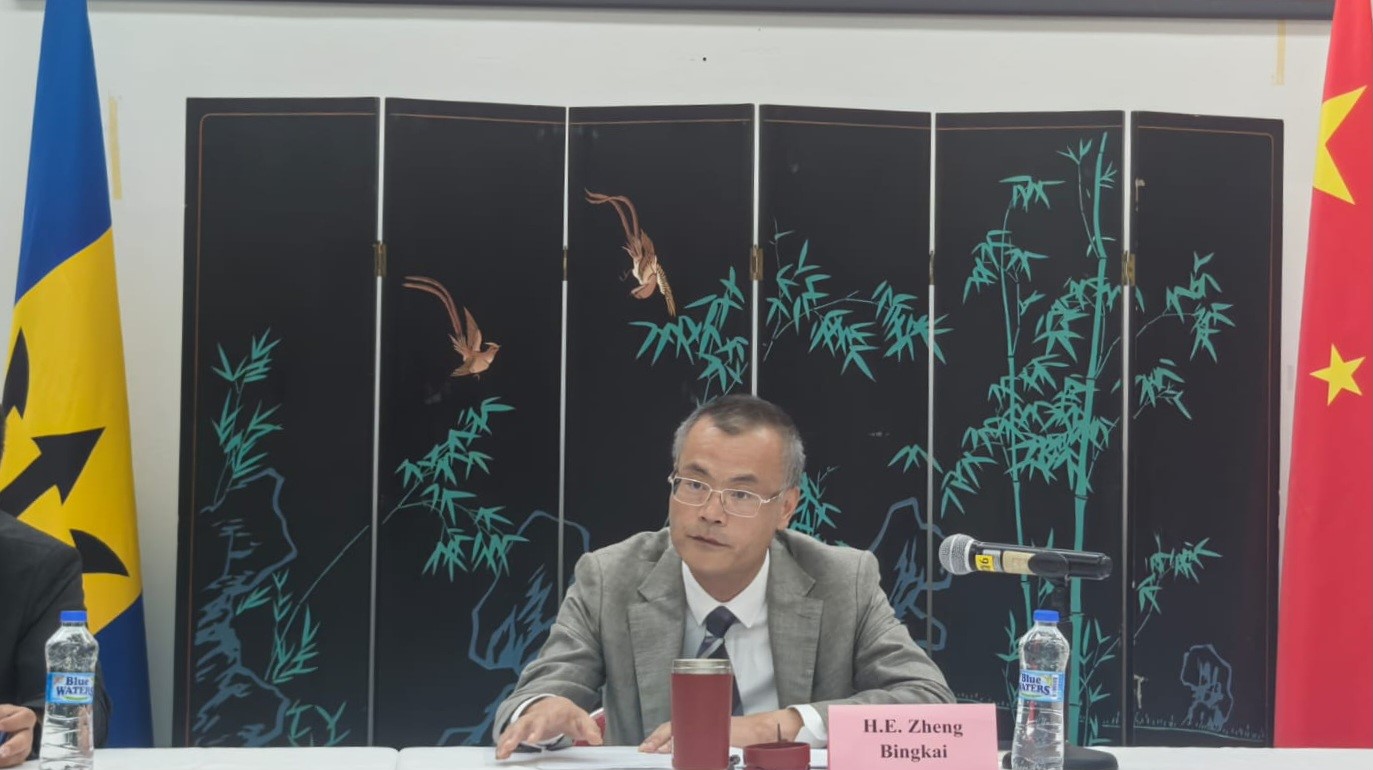
At a seminar hosted at the Chinese Embassy on July 3rd, a short film was presented on the history of the Chinese Communist Party and the extraordinary progress China has made since the founding of the party in 1921. Presentations at the seminar were made by H E ZHENG Bingkai, Ambassador of the People's Republic of China to Barbados and by Dr DeLise Worrell, President and Dr Chelston Brathwaite and Mr David Bulbulia, Vice presidents of the ABCF, as well as other attendees.
In his address Dr Worrell said:
There is a good reason why the Chinese government promotes “win-win” approaches to relations between countries: that is the foundation on which your Government’s international relations are based. Consumers everywhere owe a debt of gratitude to the Chinese government for opening up their productive economy to us, so that we can all share in the benefits that Chinese consumers enjoy.
He added that:
[The Chinese] government is a stalwart supporter of the United Nations and its agencies, a leading advocate of peace worldwide, a contributor to United Nations peacekeeping, and a promoter of international cooperation in finance and in science and technology.
As we meet on this occasion to congratulate the Chinese Communist Party-led Government of China, we look forward to a continuation of your visionary world leadership for the benefit of the Chinese people and all of humanity.
Ranked: The Countries With the Most High-Speed Rail
China operates 40,493 km of high-speed rail, more than the rest of the world combined.
Spain leads Europe with 3,993 km, ahead of Japan and France.
Morocco is Africa’s only country with a high-speed rail network, while the U.S. has just 735 km in operation.
The World's Largest Economies in 2026: Nominal vs. PPP
China ranks as the world’s largest economy by purchasing power parity (PPP), while the U.S. remains No. 1 by nominal GDP.
Adjusting for local prices reshuffles the rankings, lifting countries like India, Russia, and Indonesia.
These rankings are based on IMF projections for the world’s 20 largest economies in 2026.
Ranked: The World's Biggest Carmakers (2020–2025)
Toyota and Volkswagen remained the world’s two biggest carmakers by global vehicle sales between 2020 and 2025.
Chinese brands climbed rapidly, with BYD jumping into the global top 10 and Geely also moving higher.
Several established automakers, including Honda, Nissan, and Renault, slipped down the rankings as competition intensified.
China is running the CBDC experiment the West designed away - OMFIF
Reports in the Financial Times that China is preparing to commercialise Project mBridge, the multi-central bank platform that settles cross-border payments directly in digital currencies, have revived the familiar question of whether Beijing can loosen the dollar’s grip….
The fear is disintermediation: when the safest money in the system also earns a return, balances migrate from commercial banks to the central bank, eroding the deposit base that banks lend against and, under stress, accelerating digital runs. The orthodox response has been to keep retail digital money cash-like, unremunerated and capped.
China’s design takes the opposite turn, but with a twist that is easy to miss. It has not made central bank money interest-bearing. It has reclassified the digital renminbi held in commercial-bank wallets as a bank deposit liability: remunerated at deposit rates, covered by deposit insurance, carried on banks’ balance sheets and folded into their reserve requirements, with non-bank operators holding full reserves against the digital renminbi they distribute.
Laeven, Luc A. and Popov, Alexander A. and Cozariuc, Catalina, The rise of China in academic research (June, 2026). ECB Working Paper No. 2026/3241, Available at SSRN: https://ssrn.com/abstract=6865952 or http://dx.doi.org/10.2139/ssrn.6865952.
Analyzing more than 300,000 articles across 40 top-tier journals between 2000 and 2022, this study demonstrates that China’s 2006 National Medium-and Long-Term Plan for the Development of Science and Technology catalyzed a surge in publication volume and citations, propelling China past the United States as the world’s leading producer of scientific research. Controlling for national income, population, and human capital, we find these gains are concentrated in fields explicitly targeted by the government’s plan—physics, chemistry, biology, and medicine—while fields excluded from the plan, such as mathematics and economics, show significantly less growth. Our findings suggest that targeted state-led investment can effectively drive scientific progress, at least within a centrally planned economy.
Where Is China’s Trillion-Dollar Trade Surplus Going? by Miao Yanliang - Project Syndicate
Whereas China’s trade surplus used to be absorbed largely by the central bank and channeled into official reserves, it is now being redeployed by private actors in search of yield. This indicates China’s progress on financial deepening and underscores markets' increasingly central role in shaping the economy.
…The country’s current-account surplus for 2025 thus amounted to $735 billion—a record-breaking figure, to be sure, but much smaller than the headline-grabbing goods surplus….
Things changed around 2012, following the end of the Compulsory Foreign Exchange Settlement and Sales System, which had required domestic institutions and residents to sell all their forex income to designated state banks. As Chinese companies gained the freedom to retain their foreign earnings, the link between trade surpluses and reserve accumulation was loosened, though the PBOC retained ample reserves.
Around 2015, expectations of renminbi depreciation prompted firms and investors to adjust their forex positions: companies accumulated dollar deposits, repaid foreign-currency liabilities, and shifted funds offshore. In other words, instead of being converted into domestic foreign-exchange receipts, the surplus was increasingly held as foreign-currency assets.
After the COVID-19 pandemic, however, another shift took place, reflecting China’s continued financial opening. The private sector is still taking the lead in recycling the surplus, but it is no longer operating out of fear. The renminbi is now stable and has even appreciated against the dollar. Instead, investors and firms are searching for yield, largely through portfolio investment in bonds and equities.
Chinese companies are seeking more fresh university graduates with backgrounds in artificial intelligence this year because widespread use of the technology is making their businesses more efficient, according to a recruitment portal based in Beijing.
In the first five months of this year, nearly four out of every 10 job postings targeting fresh graduates were AI-related, compared with nearly three out of 10 in the same period last year, Maimai – a portal with 120 million users in mainland China – said on Thursday.
“AI has driven disparities in operational efficiencies across companies,” Maimai founder and CEO Lin Fan said in Hangzhou. “Against this backdrop, competition for AI and embodied AI talent has taken centre stage across the entire recruitment market.”
China’s satellite engine smashes record, leaves US rival far behind | South China Morning Post
China has tested a satellite engine with a record-breaking operating life, a key technology that could help propel the world’s largest communications, military and deep-space spacecraft into their intended orbits faster and more reliably.
The upgraded engine, developed by the China Academy of Aerospace Propulsion Technology in Xian, can produce 750 newtons of thrust, according to Chinese media reports.
The Chinese engine fired for 11,617 seconds – 3.2 hours – across five orbit-raising manoeuvres during its maiden flight in late June, placing Communications Technology Experiment Satellite 26A into orbit about 35,800km (22,000 miles) above Earth.
A demonstration wheat plot in China’s vast Taklamakan Desert has produced a harvest nearly double the national average yield recorded in 2025, according to a project announcement.
The wheat, known as Jingmai 189, was developed by the Beijing Academy of Agriculture and Forestry Sciences to withstand drought, saline soil and nutrient-poor land.
The trial on a managed, heavily saline plot produced a harvest of 768kg per mu (about 11.5 tonnes per hectare or 10,278lbs per acre) compared with the national average wheat yield of 399.2kg per mu recorded last year, the academy’s Institute of Hybrid Wheat Research said in a statement on June 23.
The Politics of Policy Research in China
The essay translated below is one such rare attempt. It does not deny that policymaking is political: policy involves power, interests, institutional authority, and the allocation of resources. But it argues that policy research itself should not be excessively politicized. Specific disagreements over policy should not be casually elevated into questions of political attitude or political loyalty. Otherwise, serious discussion becomes impossible; mistakes become harder to correct; and policy research degenerates into empty praise for decisions already made.
How Local China Built the EV Boom
A newly published paper offers a more nuanced explanation. In “The Rise of China’s Electric Vehicle Industry: Strategic Alliances Between Local Governments and Private Capital,” published in the July issue of The China Journal in 2026, Fengming Lu and Xiao Ma argue that China’s EV boom was driven in large part by alliances between ambitious local governments and agile private firms, which repeatedly found ways around tight central regulations—a dynamic that produced both China’s spectacular EV successes and many of its costly failures.
China's Hormuz lessons - by Zhu Yutao and Yuxuan JIA
Drawing on field observations and professional experience, the experts show how quickly the U.S.-Israel-Iran war hit Chinese enterprises — from Middle East orders plunging to less than one-tenth of normal levels, to higher shipping costs, longer delivery times and growing pressure on exporters to assume end-to-end logistics responsibilities.
They also make a broader point: the crisis has vindicated China’s earlier strategic judgments. Its efforts to diversify energy imports, expand strategic reserves, develop new-energy capacity and invest in overseas ports, industrial parks and logistics links have given it a degree of resilience that many economies lack. Assets that may once have looked like “strategic redundancy” in peacetime — from Hambantota and Gwadar to Duqm and Piraeus — could prove valuable backup nodes in a crisis.
More and more Africans want to learn Chinese. But who will teach them? | South China Morning Post
As China’s relationship with African countries has deepened, the country’s influence is spreading into more areas. In the first of a series of articles, Jevans Nyabiage explores how a drive to expand Chinese language education in Africa is being stymied by a shortage of teachers.
Opinion | How Chinese philosophy influenced US founding fathers | South China Morning Post
“Founding Father, Benjamin Franklin, published the sayings of Confucius in his colonial newspaper and today’s sculpture recognising that ancient Chinese age is carved into the face of the United States Supreme Court very proudly,” said US President Donald Trump in Beijing last month.
It took two-and-a-half centuries for an American president to explicitly acknowledge the profound Chinese impact on the US founding fathers. Trump’s recent declaration could be a historical first. Unless archival evidence surfaces to suggest otherwise, he is the first US president to formally recognise this intellectual gap on the world stage.
This admission stands in stark contrast to our current geopolitical discourse. Today, Western political commentary frequently depicts China as the ultimate cultural and ideological antithesis to the West. Yet, a deeper dive into history reveals that ancient Chinese philosophy did not just sit on the periphery of Western thought; it actively inspired both the European Enlightenment and the American founders.
This weekly newsletter is put together by DeLisle Worrell, President of the ABCF. Visit us at Association for Barbados China Friendship | (abcf-bb.com).
Thanks to everyone who sent contributions for this week’s Update. Please send items of interest to me via the contact page at ABCF-BB.com or to info@DeLisleWorrell.com
The ABCF mission is to build a deeper understanding between the Chinese people and Barbadians and Caribbean people from all walks of life. The association’s focus is on personal experiences, people-to-people contact, cultural exchanges and exchanges of ideas, and the facilitation of travel, business and study. From the outset we aim to learn from and build on the experiences of the Caribbean and China, and to develop mutual understandings and support that will be to the benefit of both sides.